Accountability Accelerator Newsletter, September 2024
17/09/2024
Dear Friends,

As COP16 approaches, we look forward to the excitement building among a wide range of governments, observer organisations, indigenous communities, businesses, youth groups, civil society, academia, and the general public, all united in their pursuit of achieving the goals of the Global Biodiversity Plan and halting and reversing nature loss by 2030.
With this hopeful sentiment in mind, we are organising a few sessions at COP16 in Cali to bring together these diverse actors and their different perspectives. We would like very much to welcome you there if you are able to attend. If you haven’t already done so, please reach out!
One emerging face of accountability is ensuring that the transition to renewable energy is sustainable at this critical time, and we are addressing the need for transparency and responsibility across the transition mineral supply chain. To this end, we will be holding a virtual convening on September 19th. Together with our grantees and partners involved in transition mineral projects in Indonesia and other regions, we will explore some important challenges related to the protection of ecosystems and local communities in affected areas. Please let us know if you would like to attend or contribute to the session.
We will also have a presence at Climate Week NYC—details below—so do reach out if you are planning on being there and would like to attend any of our events or meet up for a chat.
Aligning Action on Climate and Nature Workshop
London Climate Action Week, June 2024
We are excited to share insights from our recent workshop, which united key leaders and stakeholders to discuss the critical alignment of corporate commitments to climate and nature. During the workshop, we delved into how corporate commitments can support the goals of the Paris Agreement and the Global Biodiversity Framework (GBF). The focus was on driving tangible, verifiable actions to bridge gaps in the current accountability landscape.
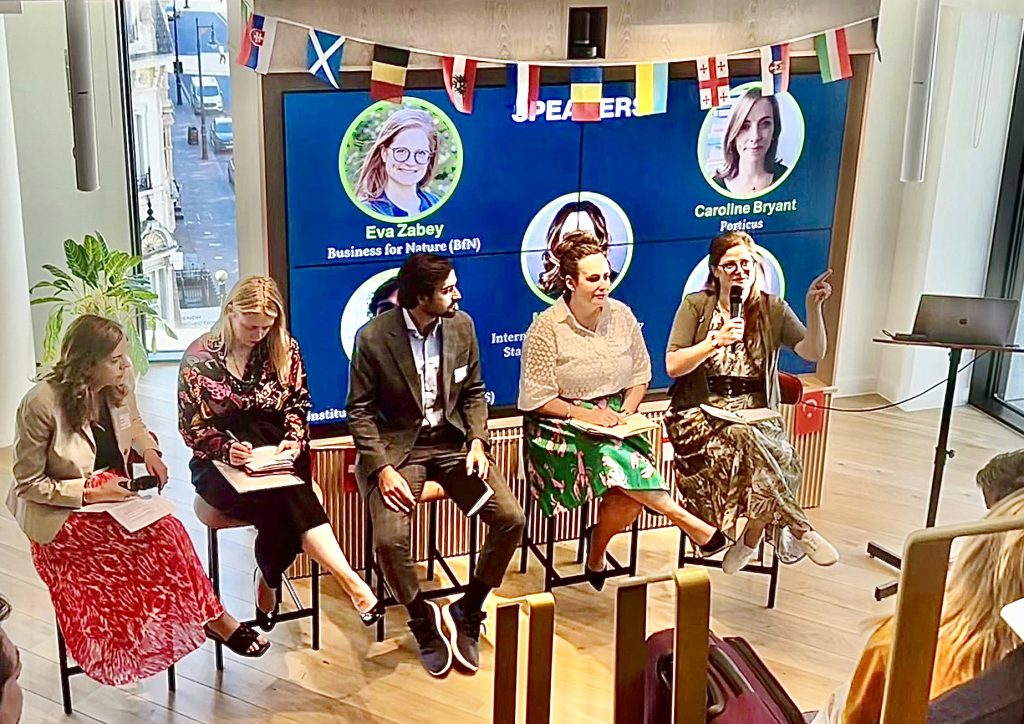
Four distinguished speakers shared their insights on the corporate accountability ecosystem:
- Eva Zabey, CEO, Business for Nature: Discussed the role of governments in setting regulations and how companies can hold them accountable, emphasising the importance of policy and regulatory environments.
- Mardi McBrien, Chief of Strategic Affairs & Capacity Building, IFRS Foundation: Highlighted the implementation of corporate accountability in Europe and the ISSB’s efforts to build capacity and align climate disclosure with nature.
- Lucca Rizzo,Climate Finance – Special Advisor to the CEO, Instituto Clima e Sociedade: Spoke on the critical role of the G20 in the run up to COP 30 next year, including supporting events held throughout 2024, such as the Brazilian Climate Finance Forum in February, as well as the C20 civil society summit and the F20 Foundations meetings over the summer. These will be critical in bringing together climate and nature and in setting up the framework for deeper accountability for companies.
- Char Love, Global Director of Advocacy, Natura & Co.: Provided a corporate perspective on nature accountability, stressing the need for businesses to make net-positive impacts on communities and landscapes. She also noted the importance of inspiration, quoting Nigel Topping, ‘We must be guided by the science and moved by the poetry’.
Following the panel, our Executive Director, Natasha Matic, presented the Accelerator’s mission through our three primary activities: grant-making, orchestration and convening, and SBT Validation. As a re-granter and intermediary with a deep understanding of this space, we support and coordinate organisations that are filling critical gaps, ensuring that existing solutions are leveraged effectively.
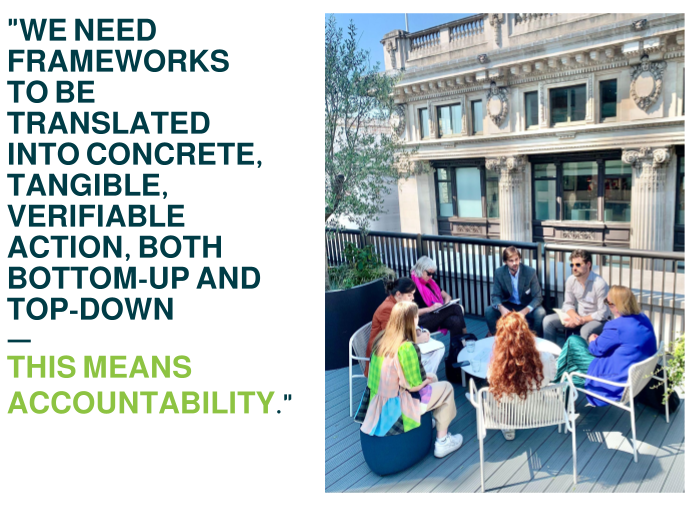
Our mission is simple but ambitious – we aim to drive corporate and financial institutions’ action to stop and reverse harm to nature through an impactful accountability ecosystem. We need frameworks to be translated into concrete, tangible, verifiable action, both bottom-up and top-down — this means accountability. And right now, there are still many gaps and silos in the accountability architecture.
During the breakout sessions, participants engaged in lively discussions to address critical questions, such as how climate initiatives can learn from nature on accountability and vice versa, identifying gaps in the current accountability ecosystem, and outlining the necessary steps for alignment leading up to COP30. The highlights of this discussion were:
- Corporate accountability must be enhanced. The necessary standards for Nature are in place, but commitments need to be translated into concrete actions: from targets to transition plans, and from transitions to business plans.
- There are gaps in the accountability ecosystem. Capacity building is key for both companies and NGOs. Aligning nature and climate efforts is essential, as is breaking silos between the Global North and South. Policy and regulation enforcement must also be strengthened.
- A common narrative and unified voice for nature is needed. A unified voice for nature is needed. Climate Champions should evolve into Planet Champions, and Climate Weeks should expand to include nature and justice.
- Accountability starts with a change in culture. Organizational transformation starts at the top and spreads throughout. Culture plays a crucial role in driving this change, as emphasized by participants.
Special thanks to Porticus and the European Climate Foundation for co-designing and co-hosting this impactful event with us!
DEEP DIVE:
The Accountability Accelerator Legal Cluster
The Legal Cluster is working with accountability NGOs supporting communities’ whose nature related rights are being affected in the Democratic Republic of Congo, Zimbabwe, Kenya, Liberia, Mongolia, Mexico, Chile, Brazil and the USA. The cluster’s goal is to support a legal architecture that ensures responsible business action and eliminates harm to nature and people. In our grant-making, this includes supporting legal tools such as: testing the implementation and interpretation of existing regulations, exposing policy and regulatory gaps of environmental risks, documenting contamination and Indigenous Peoples’ rights abuses, and building community awareness and accessing legal advice.
We recently invited grantees to share their views on priorities and where support is needed. Below are five key take-aways from that discussion:
Take-away #1 – The Accelerator’s legal work must remain grounded, particularly in the Global South, and aim to bridge between the local, to the regional and global conversations. Grantees stressed the need for two tracks: for policy work that complements evidence-based case work and reflects the on-the-ground realities of Global South based Indigenous Peoples and local communities.
Take-away #2 – Grantees expressed appreciation for the Accelerator’s ambition to be accessible, quick, and responsive, however, we need to explore alliances with other legal funders to secure longer-term support to scale up and continue successful pilots, projects, or initiatives we fund.
Take-away #3 – The Accelerator’s legal work needs to create new linkages and networks, including by building on existing alliances, between regions and globally, with the aim of connecting local actors globally. Grantees expressed feeling isolated at times in their work, particularly as smaller grass-roots organisations, and highlighted the benefits of being connected and sharing strategic learnings.
Take-away #4 – The Accelerator’s legal work and support needs to continue to centre justice and equity, including by ensuring that new and existing policies and regulations that are corporate-nature relevant are appropriately enforced. Grantees shared that new laws are a step forward, however, now work needs to ensure that these are accessible and equitably enforced, particularly for Global South place-based harms.
Take-away #5 – The Accelerator’s legal work must ensure support for the protection of environmental defenders across our efforts to support a robust Legal & Nature accountability ecosystem. As we support building local to global links, including by exposing poor industry practices and centering Indigenous Peoples and local communities, we need to ensure appropriate resourcing for protection-related issues.
NEW GRANTEES
We are excited to share that we are supporting the following grants this quarter:
- Auriga Nusantara ( Data & Standards) Avoiding deforestation and improving post-mining rehabilitation through powerful public monitoring and ESG implementations in the critical mineral sector in Indonesia
- Business and Human Rights Resources Centre (Campaigns) Using their vast network of regional researchers they will undertake a fact finding mission to mining affected areas in Indonesia alongside local partners to systematically gather and document data on the socio economic and environmental impacts of transition minerals extraction on Indigenous Peoples, local communities, and workers.
- Perennial Land (Campaigns) We are supporting the exhibit Perennial Land:The Data Forest, which is an experiential installation and the creation of Isabel Duverger and Laia Cabrera. Our belief is that this combination of art, nature and technology, can raise awareness and inspire action to combat nature loss.
- Rethinking Removals (Data & Standards) The United Front for Nature and Net Zero is a temporary initiative designed to rally the leaders of the nature and climate communities around a cohesive and collective vision of what good science-based corporate action looks like, and clarify who is accountable for enabling, requiring, and monitoring action across reductions, removals, and nature.You can explore past grantees and projects on our website HERE
UPCOMING EVENTS
Transition Minerals in Indonesia: The accountability challenge
Thursday, September 19th at 4pm Jakarta / 11 am CET
transparency across supply chains and protection of ecosystems and local communities. South East Asia, especially Indonesia, faces significant challenges as a major nickel producer. We invite you to join an online meeting with our grantees and partners to discuss these critical issues.
As demand for transition minerals rises, it’s crucial to ensure that renewable energy development is sustainable, with
Climate Week NYC
While the Accountability Accelerator won’t be hosting a standalone event, we will have a small team present and will support some events organized by the Global Commons Alliance and focused on strengthening and expanding our network, building relationships and collaborating with key stakeholders to further our mission. Join us and the other components of the Global Commons Alliance—Earth Commission, Earth HQ, Science Based Targets Network, and Systems Change Lab—in New York for Climate Week NYC and the UN Summit of the Future from 20-29 September 2024. Find all the events here.
COP16
We’re thrilled to share our latest updates with you as we gear up for COP16 in Cali, Colombia in October. The Accountability Accelerator and the GCA as a whole will take the opportunity to further engage in “Safe and Just dialogues” in Cali and will be present in the Blue and Green Zones. Our team is eagerly preparing to bring our community together in person, with several key events planned over the course of the two weeks:
- Find your match to drive action for a safe and just planet
Thursday, 24 October, 10:30-11:30, Nature Positive Pavilion
In an interactive workshop, like minded partners of the Global Commons Alliance will discuss how the topic of choice fits in a whole earth system’s approach. Participants will explore key enablers to accelerate the transition pathways and the needed system shifts for a safe and just planet. What can this whole earth system approach bring to your specific topic and accelerate as well as enrich the implementation of the Global Biodiversity Framework? The goal is to come up with 3 key actions to feed in the transition pathways ensuring no significant harm to people and a nature positive future is delivered by 2030.
- Perennial Land
Friday, October 25, 09:00-17:00, Nature Positive Pavilion
We are excited to have the opportunity to be showcasing one of our latest grantees, an exhibit called Perennial Land: The Data Forest. This is an experiential installation and the creation of Isabel Duverger and Laia Cabrera, artists who have been collaborating for the past 15 years to create impacting visual narratives. This project is an immersive video installation which invites the audience into a contemplative and immersive space, surrounded on three sides by running images of Earth’s Forest environment, interspersed with climate/nature data and scenes of human planetary relations gone awry. Our belief is that this combination of art, nature and technology, can raise awareness and inspire action to combat nature loss. Do not miss it if you are in Cali!
- Accelerator Grantee and Stakeholder Accountability Workshop
Saturday, October 26, Invitation Only
We have already confirmed a venue and a date to bring together our most impassioned and committed grantees, funders, and partners who will be present at COP16. This workshop will foster learning and collaboration, exploring how stakeholders can support corporate accountability in achieving GBF targets. IPLC will be a crucial part of this workshop at the “People’s COP.”
- Technology and Corporate Nature Action: Strengthening Accountability in the Global South
Wednesday, 30 October, 10:30-11:30, Nature Positive Pavilion
This session will showcase how groundbreaking accountability tools and technologies are driving corporate nature and climate action in Africa, Indonesia, and Latin America. Learn how local organizations are using innovative platforms to ensure corporate and governmental transparency and responsibility. Featured case studies include: Southern Africa Resource Watch on citizen empowerment app to improve mining transparency and accountability; Auriga Nusantara on their data platform for real-time monitoring of deforestation in Indonesia’s mining regions; and Fundación Avina on stakeholder mapping of accountability actors in the Amazon and Chaco biomes.
- Setting and Validating Corporate Science-Based Targets for Nature
Wednesday 30 October, 12:00-13:00, Nature Positive Pavilion
Based on learnings from the SBTN target-setting validation pilot, a mid-term (2024-2026) independent validation model is being led by the Accountability Accelerator. Over the past six months, the Accelerator has been working on the development of a Validation Platform to enable a robust validation process, training new validators, and following best practice guidance from ISEAL on governance and assurance. In this session, a panel will discuss the experience with the new validation process, the importance of corporate engagement, and the role of voluntary and regulatory frameworks in inspiring other companies to follow.
- From Science to Action – For a just world on a safe planet
Timing TBC, Colombia Pavilion
This session will present the main conclusions of the first assessment of the Earth Commission, focused on the Safe and Just boundaries for biodiversity. During this session, a deep and dynamic dialogue and exchange will be opened about the second assessment, which is currently underway, to obtain comments and suggestions on how this assessment can be a more useful tool for decision-makers on these critical issues for the planet’s health.
- High-Level Panel on Accountability (TBC)
The Accelerator is awaiting approval for a high-level panel with business, government, and accountability stakeholders. This panel will advocate for increased accountability for nature across various sectors and explore the role of a UN High-Level Expert Group (HLEG) on Nature.
WHAT WE ARE READING?
And finally, here is our list of interesting articles and reports that have caught our attention over the past few months:
- Path to prosperity for planet and people if Earth’s critical resources are better shared (Global Commons Alliance / Lancet Planetary Health)
- COP16 – What Should Business Leaders Expect? (Forbes)
- Framework for implementing environment, social and governance (ESG) (ISO)
- Help stop an uncontacted tribe being wiped out to produce electric car batteries (Survival International)
- Research shows major companies around the world are failing to assess and measure their impact on nature (World Benchmarking Alliance)
- Despite Anti-ESG Attacks, New Study Shows Investors See Climate as Critical to Business Performance (HBR)
- Indigenous Leaders to Convene at Global Summit about the Energy Transition (SIRGE Coalition)
- Causing environmental damage should be a criminal offence, say 72% of people in G20 countries surveyed (Global Commons Alliance)
- The Time to Act Is Now: The world’s highest court must weigh in strongly on climate and nature (Nature)
- Resourcing the Energy Transition: Principles to guide critical energy transition minerals towards equity and justice (UN Secretary-General’s Panel on Critical Energy Transition Minerals)
- No basis for claim that 80% of biodiversity is found in Indigenous territories (Nature)
- Unjust minerals: investing in the changes needed for a just transition in the mining sector (Just Transition Finance)
- ICMM – Indigenous Peoples and Mining: Position Statement (ICMM)
- Climate policies that achieved major emission reductions: Global evidence from two decades (Science)
- Johan Rockström: The tipping points of climate change — and where we stand (TED Talk)
- Humans know very little about the deep sea. That may not stop us from mining it (Grist)
- Minimizing Mining Impacts on the Road to Zero Emissions Transport (Earthworks)
With gratitude for your partnership and continued support,
Natasha M. Matic, Ph.D.
Executive Director
Accountability Accelerator
Part of the Global Commons Alliance (GCA)
Follow us on LinkedIn