COP30 in Belém: Accountability or Bust
26/11/2025
By Dr. Natasha M. Matic, Executive Director, Accountability Accelerator
Watching COP30 unfold from a distance offers a clarifying perspective. You see the architecture of the summit without getting swept into its noise, tensions or optimism. From that vantage point, one truth is unmistakable: after three decades, thirty climate summits, public trust in the structures and frameworks that make up the COP process is wearing thin.
The science is clearer than ever. The warnings are louder. The solutions are more affordable. Yet global emissions are still rising, and current policies point toward roughly 2.6°C of warming – far beyond what any stable economy or society can withstand. Governments announce climate pledges while licensing new oil and gas. Renewables attract twice the investment of fossil fuels, yet fossil production continues to grow. Capital is accelerating and braking at the same time.

Paul Polman summed it up well: the transition will live or die based on whether it is fast enough and fair enough to improve people’s lives. Philanthropy and business have an outsized influence on both. If the transition feels fair, affordable, and hopeful, business and philanthropy will be at the center of that success. If it feels extractive and inequitable, business will be at the center of the backlash.
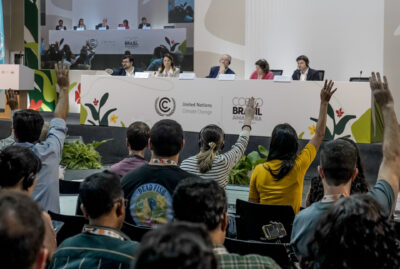
COP30 in Belém took place against this backdrop. From where I watched – not in the halls, but in the signals, chats, media coverage and WhatsApp groups – I tracked the summit against four standards that the Accountability Accelerator believes are now non-negotiable for credible climate action:
- Turning commitments into measurable action
- Embedding accountability
- Integrating climate and nature
- Elevating Indigenous and civil society leadership
Turning commitments into clear action
COP30 opened with unusually blunt messaging. The UN Secretary-General’s call to “stop announcing, start implementing” reverberated beyond Belém. He declared that “it’s no longer time for negotiations – it’s time for implementation, implementation, implementation,” calling for independent tracking of commitments. The “Mutirão” decision to triple adaptation finance by 2035, and the launch of a Belém Mission to 1.5°C, are meaningful steps toward delivery. The move to develop 59 global adaptation indicators is another sign that implementation is no longer assumed: it must be proven.
For philanthropy and business, these signals matter. They indicate a future where financing will be tied to verified outcomes, not just policy alignment or branded ambition. The new EU–African Development Bank pilot, which ties concessional loans to verified decarbonization milestones, sets a template worth €15.5bn. The era of receipts, not rhetoric, is coming.

Yet ambition still lacks urgency. Tripling finance by 2035 is still not fast or strong enough given how rapidly climate and nature breakdown are happening. And without roadmaps for fossil-fuel phase-down, the credibility gap remains. Philanthropy and business can fill this gap by backing implementation, not just commitments.
Accountability at the centre
Accountability is no longer a technical afterthought. It is the litmus test of seriousness. Governments, investors and insurers can no longer rely on voluntary reporting, and businesses are moving toward external validation frameworks. At COP30, the shift toward measurement showed up in indicators, financial conditionality, and reporting mechanisms. But measurement without enforcement risks becoming greenwashing and performance art.
This is where philanthropy and business leadership can become transformational. Investors, corporates, and funders can embed accountability through:
- Verified transition plans
- Nature-positive supply chains, including procurement standards, transparent reporting and supplier requirements
- Traceable finance
- Support for watchdogs, data systems, and community-led monitoring

These are not compliance expenses, they are the building blocks of trust-building infrastructure. They enable the transition to scale without losing credibility. These solutions exist. Verified transition plans, traceable finance, embedding accountability for nature across supply chains, and community-led monitoring are not new ideas – they are tools we need to deploy consistently, transparently, and at scale.
Climate and nature interlinked
COP30 made it harder than ever to pretend climate can be fixed without nature. In Belém, the Amazon itself served as a negotiation partner. Forest loss, ecosystem collapse, and climate breakdown are converging crises. The Tropical Forest Forever Facility and nature-based resilience frameworks signal movement toward scaling nature finance. The joint statement from the three Rio Conventions – climate, biodiversity, and land degradation, which were long managed in separate silos, were finally treated as one system. This marked a critical step forward.
However, much of this sits outside the official UN text, making it vulnerable to political shifts and philanthropic fickleness. We need finance and business models that treat nature as infrastructure: essential, investable, and governed by science. The transition is not a carbon project; it is an ecological transformation.
For philanthropy and business, this presents the greatest opportunity: a market and development shift from extracting value to creating regenerative value. Instead of profiting from depletion – of carbon, forests, minerals, or human labour – long-term returns will come from investing in ecosystems, communities, and supply chains that can renew, not exhaust, the resources they depend on. Companies and capital markets that enable regeneration will outperform those built on extraction.
Indigenous and civil society leadership: From consultation to governance
The most consequential COP30 developments were not only financial or technical. They were about people. The Intergovernmental Land Tenure Commitment, covering up to 160 million hectares and backed by $1.8 billion, marks a shift from symbolic recognition to legal authority for the communities who protect ecosystems. The Indigenous Leaders’ Forum Declaration, proposing legal personhood for the Amazon, challenges philanthropy and business to support rights-based climate action, not extractive climate solutions.

Accountability cannot exist without those who protect nature having power, not just seats at the table. Consultation alone is not consent.
The road from Belém
COP30 did not resolve the trust crisis, but it made the stakes clearer. The transition will succeed if it improves daily life, protects nature, and is verified, not promised. For philanthropy and business, this is not just responsibility, it is a generational opportunity.

Nature, markets, and communities will respond to what we deliver – not what we declare. The next decade will not reward those who promise ambition, but those who deliver proof. We must back more than aspiration, we must back accountability.